
 Rock
 Aggregate
 Cement
 Concrete
 Soil
 Steel
 Bitumen/Asphalt
 Security Survey Equipment
 General Items
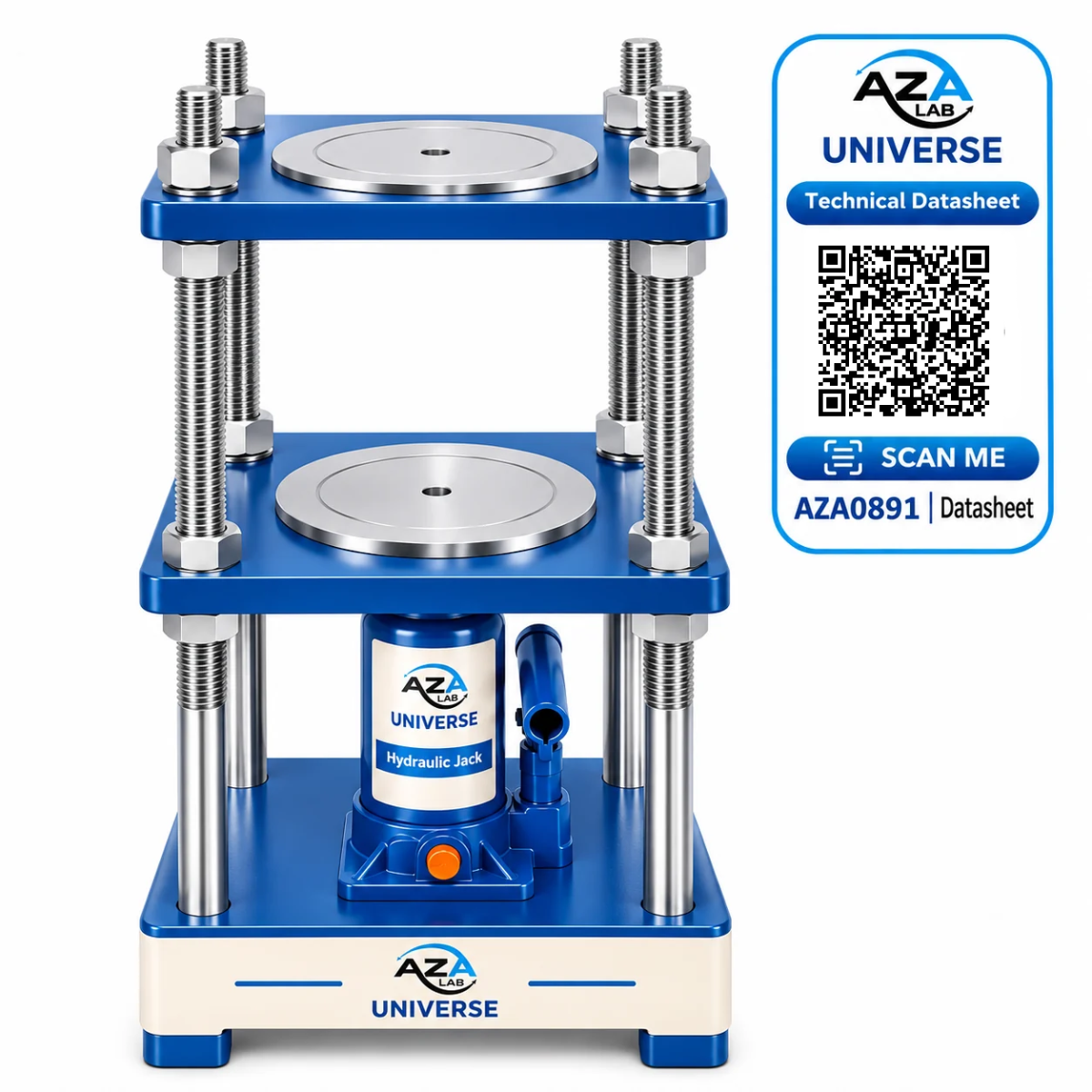
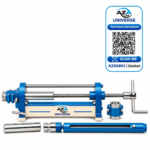
UNIVERSAL EXTRUDER FRAME HYDRAULIC AZA0891
The AZA0891 hydraulic extruder uses a 50 kN hand-operated jack mounted on a frame to extract soil specimens from moulds. Supplied with 100 mm and 150 mm plungers and an adjustable thrust plate. Adaptors for 38, 50 and 75 mm specimens and a motorised version are available.
Description
Description
TECHNICAL SPECIFICATIONS
| Parameter | Specification |
| AZA LAB Model | AZA0891 |
| Equipment | Universal Extruder Frame Hydraulic |
| Application | Extraction of soil specimens from moulds |
| Operating mechanism | Hand-operated hydraulic jack |
| Hydraulic jack capacity | 50 kN |
| Construction | Hydraulic jack mounted on supporting frame |
| Standard plunger – 1 | 100 mm (4 in) diameter mould |
| Standard plunger – 2 | 150 mm (6 in) diameter mould |
| Thrust plate | Adjustable height |
| Accessories | Set of plunger adaptors and thrust plates for 38, 50 and 75 mm diameter specimens |
| Alternative version | Motorised model available on request |
Additional information
Additional information
| Model Number |
AZA 0891 |
|---|---|
| Type |
Universal Extruder, ZI 3045 Frame |
| Operation |
Hydraulic (manual hand pump or electric pump option available). |
| Purpose |
Gentle and controlled soil sample extrusion from sampling tubes. |
| Sample Type |
Primarily for undisturbed samples. |
| Weight |
Substantial due to robust construction and hydraulic components. |
| Finish |
Corrosion-resistant coating suitable for geotechnical lab environments. |
Related products
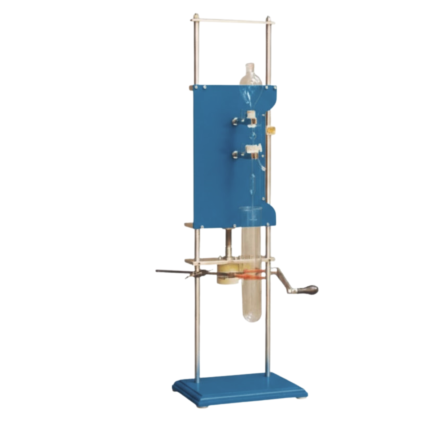
GRAIN SIZE ANALYSIS (PIPETTE METHOD) AZA0856
The AZA0856 Grain Size Analysis (Pipette Method) Apparatus from AZA Lab is a precision testing setup used for determining the distribution of fine soil particles such as silt and clay. It is widely used in geotechnical engineering, civil construction quality control, soil mechanics research, and academic laboratories, particularly where conventional sieve analysis is ineffective for particles finer than 75 microns.
This apparatus is designed for the mechanical analysis of sub-sieve soil particles, expressing quantitatively the proportion by weight of various particle sizes present in a soil sample. The pipette method, based on sedimentation principles and Stokes’ Law, provides accurate and repeatable results for fine-grained soils.
The system consists of a sliding vertical panel operated by a precision screw mechanism, allowing an Anderson pipette to be raised or lowered accurately. A sedimentation tube is held securely below the pipette using a laboratory clamp. The depth of immersion is measured using a millimeter-graduated scale mounted alongside the sliding panel.
The apparatus is supplied complete with a 10 ml Anderson pipette, a 500 ml glass sedimentation tube, and test form pads, conforming to standard laboratory practices.
LIQUID LIMIT DEVICE WITH COUNTER AZA0853
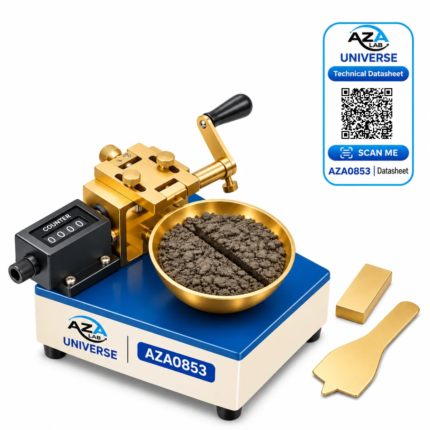
The AZA0853 Liquid Limit Device with Counter is a mechanically operated Casagrande apparatus used to determine the liquid limit of soil. A brass cup mounted on an adjustable bracket is raised and dropped onto a rubber base by a cam mechanism. The adjustable 10 mm drop and integrated blow counter support the standard groove-closure procedure. The apparatus is supplied with Casagrande and ASTM grooving tools and a height gauge block.
PARTICLE SIZE SEDIMENTATION (HYDROMETER METHOD) AZA0857
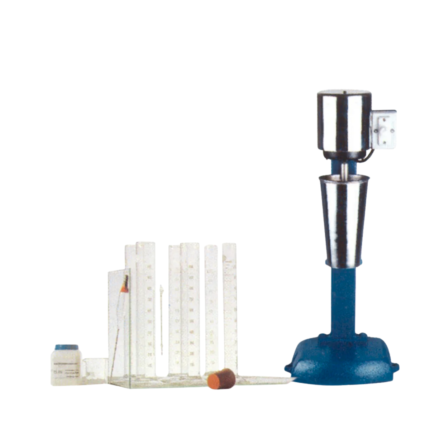
AZA0857 – Particle Size Sedimentation Apparatus (Hydrometer Method)
The AZA0857 Particle Size Sedimentation Apparatus (Hydrometer Method) from AZA Lab is designed for determining the particle size distribution of fine-grained soils, particularly silts and clays smaller than 75 microns. This method is widely adopted in soil mechanics, geotechnical engineering, civil construction quality control, and academic laboratories where accurate characterization of cohesive soils is essential.
The hydrometer method is based on the sedimentation principle governed by Stokes’ Law, measuring changes in the density of a soil–water suspension over time. By recording hydrometer readings at defined intervals, the percentage of soil particles remaining in suspension is calculated, enabling precise determination of grain size distribution for fine soils beyond the practical limits of sieve analysis.
PLUMMET BALANCE AZA0862
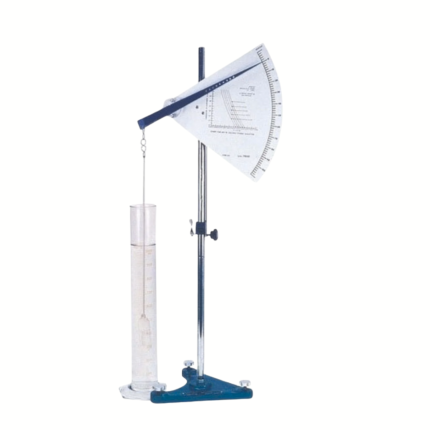
The AZA0862 Plummet Balance is a specialized laboratory apparatus designed for determining the specific gravity of fine-grained soils, particularly clays and silts that are difficult to test using conventional pycnometer methods. It is widely used in geotechnical engineering, soil mechanics laboratories, and construction quality control applications.
Manufactured by Azalab, the instrument complies with ASTM D854 and IS 2720 (Part 3 / Sec 1) standards and provides rapid, repeatable, and reliable results for dispersed soil samples commonly used in sedimentation, pipette, and hydrometer analyses.
Working Principle
The plummet balance method determines the specific gravity of soil solids by measuring the apparent weight of a suspended plummet immersed in a soil–water suspension. The balance pointer directly indicates the percentage of soil in suspension via a calibrated scale, eliminating lengthy calculations.
A rack-and-pinion height adjustment allows the plummet to be positioned at the required depth. The percentage of soil in suspension is read directly from the graduated scale, making this method faster and more user-friendly than traditional sedimentation calculations.
The set is supplied with a temperature correction chart relating the constant K to suspension temperature for soils with specific gravity ranging from 2.4 to 2.8, facilitating accurate application of Stokes’ law.
POCKET PENTROMETER AZA0869
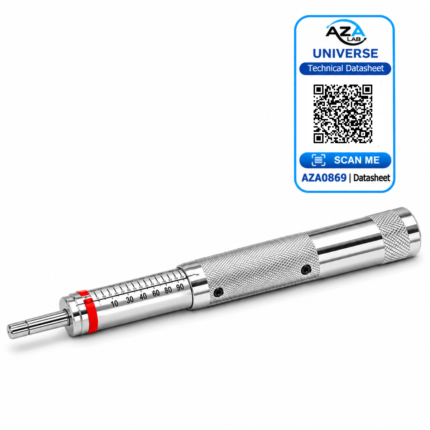
The AZA0869 Pocket Penetrometer is a compact, portable instrument featuring a lightweight barrel assembly and a polished, ground-steel loading piston. Its engraved scale provides direct load readings in kg/cm², while a maximum-load indicator ring retains the peak reading. A heat-treated, plated calibration spring provides resistance to corrosion. Supplied complete with a carrying case.
PROCTOR NEEDLES (SPRING TYPE) AZA0868
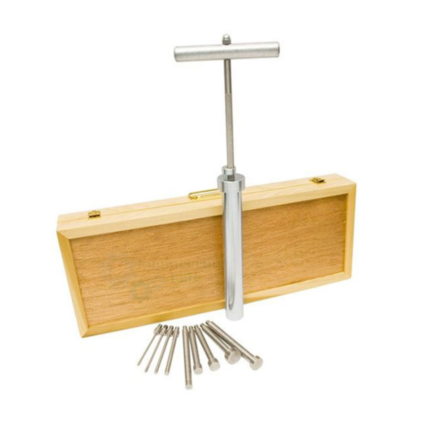
The AZA0868 Precision Proctor Needles (Spring Type) from Azalab are designed for rapid, on-site estimation of soil compaction and moisture condition. This portable instrument provides a practical alternative to full laboratory Proctor testing for preliminary assessment and quality control, particularly on cohesive and semi-cohesive soils encountered in embankments, subgrades, and trench backfills.
The instrument employs a calibrated, spring-loaded plunger to measure penetration resistance directly (0–40 kg range). Two graduated stems allow accurate tracking of penetration depth, while a comprehensive set of interchangeable needle tips enables testing across a range of soil densities and particle characteristics.
Applications
- Field assessment of soil compaction
- Estimation of optimum moisture condition
- Subgrade, fill, and trench inspection
- Construction quality control checks
- Geotechnical and educational field investigations
SAND EQUIVALENT TEST SET AZA0859
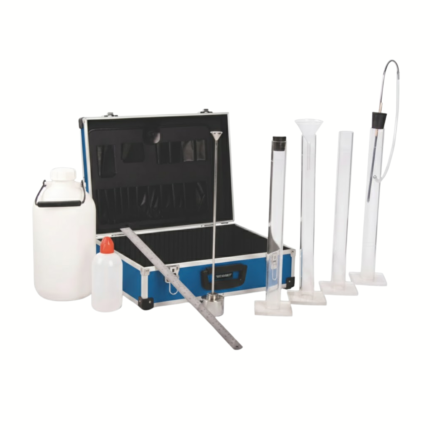
The AZA0859 Sand Equivalent Test Set from AZA Lab is a standardized laboratory and field testing apparatus used to determine the relative proportion of sand versus clay-like or plastic fines in fine aggregates and granular soils. This test is critical in construction quality control where aggregate cleanliness directly affects the performance of asphalt pavements, concrete mixes, and base course layers.
The test set conforms to ASTM D2419, IS 2720 (Part 37), and AASHTO T176, ensuring accurate, repeatable, and specification-compliant results. The Sand Equivalent Value (SEV) provides a simple numerical indication of aggregate quality by comparing the height of settled sand to the height of clay suspension after sedimentation.
Working Principle
A prepared fine aggregate sample is placed in a graduated cylinder and mixed with a standard calcium chloride-based solution. After agitation and a controlled settling period, heavier sand particles settle at the bottom while lighter clay and silt particles remain in suspension.
The Sand Equivalent Value (SEV) is calculated as:
SEV = (Height of Sand / Height of Clay Suspension) × 100
Higher SEV values indicate cleaner aggregates with lower clay contamination, which are preferred for structural and pavement applications.
SEMI AUTOMATIC CONE PENETROMETER AZA0852
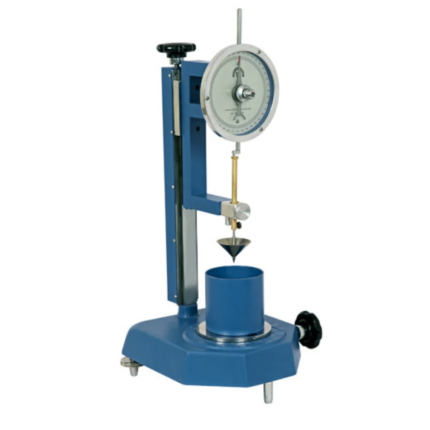
The AZA0852 Semi Automatic Cone Penetrometer from AZALAB is a precision-engineered laboratory instrument used for determining the liquid limit and consistency characteristics of fine-grained soils. Designed to eliminate operator-dependent errors, this semi-automatic model ensures uniform cone release and repeatable penetration results, making it an ideal choice for geotechnical, civil engineering, and construction material testing laboratories.
The apparatus conforms to IS 2720 (Part 5) and BS 1377 standards and is widely used for soil classification, foundation assessment, and settlement analysis. Its semi-automatic clutch-based drop mechanism allows the cone to penetrate the soil sample under controlled conditions for a fixed duration of 5 seconds, ensuring consistent and reliable test outcomes.
Principle of Operation
A soil paste prepared at known moisture content is placed in the sample cup. The standardized cone, attached to a calibrated weight, is released using the semi-automatic clutch mechanism, allowing free fall penetration into the soil. After the specified time (typically 5 seconds), the penetration depth is measured using a high-precision dial gauge. The moisture content corresponding to a penetration of 20 mm is considered the liquid limit of the soil, as defined in IS and BS standards.