
 Rock
Rock Aggregate
 Cement
 Concrete
 Soil
Soil Steel
Steel Bitumen/Asphalt
 Security Survey Equipment
 General Items

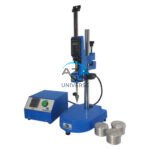
MORTAR PENETROMETER AZA1115
The AZA1115 ASTM C403 Mortar Penetrometer is a precision-engineered device designed to determine the rate of hardening and setting characteristics of mortar extracted from freshly mixed concrete. Fully compliant with ASTM C403, this instrument enables accurate measurement of penetration resistance to identify both initial and final setting times of cementitious mixes.
Built for field and laboratory use, the AZA1115 features a robust spring-loaded mechanism, a clearly graduated force scale, and six interchangeable penetration needles suitable for various mortar stiffness conditions. Its durable construction and protective wooden case make it a dependable tool for quality control engineers, construction sites, and RMC labs.
Key Features
- Complies with ASTM C403 Standard
- Used to determine mortar hardening rate
- Spring-loaded stem graduated 0–70 kg (1 kg divisions)
- Includes six interchangeable stainless steel needles
- Measures resistance at 25 mm penetration
- Shanks marked every 5 mm for depth guidance
- Supplied in a polished wooden carrying case
- Suitable for both laboratory and on-site QC
Description
Product Overview
The AZA1115 Mortar Penetrometer incorporates a calibrated spring barrel connected to a precision stem. A sliding ring captures the peak penetration resistance, enabling repeatable and consistent readings. Needle selection is based on mortar stiffness, ensuring accurate performance across early and late setting stages.
This penetrometer provides essential data for:
-
Initial and final setting time determination
-
Hardening rate of mortar extracted from concrete
-
Compliance verification with ASTM C403
-
Cement, admixture, and RMC mix characterization
-
Construction quality control and monitoring
The unit is housed in a protective wooden case to ensure safe transport and long-term durability.
Technical Specifications
| Feature | Detail |
|---|---|
| Model | AZA1115 |
| Standard Compliance | ASTM C403 |
| Measurement Range | 0–70 kg (1 kg increments) |
| Needles Included | 6 needles (645, 323, 160, 65, 32, 16 mm²) |
| Penetration Depth | 25 mm (depth marks every 12.5 mm) |
| Display Type | Analog spring mechanism with sliding ring |
| Construction | Hardened steel stem, corrosion-protected parts |
| Carrying Case | Wooden box |
| Application | Mortar extracted from sieved fresh concrete |
Applications
-
Determining initial and final setting times
-
Measuring hardening rate of sieved mortar
-
QC testing in construction sites, RMC plants, and cement labs
-
Verifying conformity to ASTM C403 requirements
-
Tracking penetration resistance at controlled depths
Frequently Asked Questions (FAQ)
Q1: What does the AZA1115 penetrometer measure?
It measures penetration resistance of mortar to determine setting time and hardening rate per ASTM C403.
Q2: Can it be used directly on concrete?
No. The test must be performed on mortar sieved from fresh concrete.
Q3: What needle sizes are included?
Six needles: 645, 323, 160, 65, 32, and 16 mm².
Q4: How is penetration depth monitored?
The stem is marked every 12.5 mm, and force is recorded when the needle penetrates 25 mm.
Q5: Is calibration required?
Yes, periodic calibration is recommended for accuracy. Calibration services can be provided upon request
Related products
BEAM MOULD AZA1124
Purpose & Importance
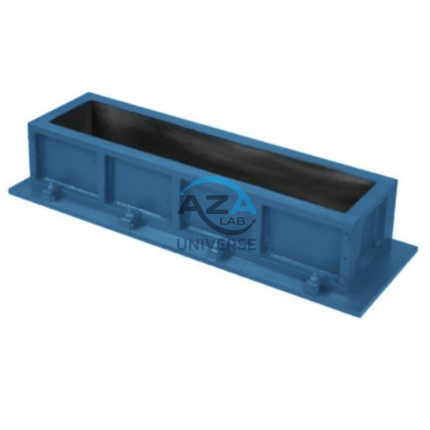
Flexural strength testing evaluates a concrete beam’s ability to resist bending stress. Standards such as IS 516, ASTM C78, and BS EN 12390-5 specify strict guidelines for specimen dimensions and surface finish. The AZA1124 Beam Mould enables users to produce uniform, high-quality concrete beams with precise cross-sections, ensuring reliability and compliance during flexural strength evaluation.Beams cast from AZA1124 are used for:
- Flexural tensile strength testing
- Load-bearing capacity studies
- Structural behavior simulations
- R&D on mix designs and reinforcement additives
Ideal for:
- Civil engineering research laboratories
- Cement product quality assurance departments
- Construction material testing centers
- Technical universities and engineering institutions

CHASE AIR INDICATOR AZA1105
AZA1105 Chase Air Indicator is a compact, lightweight, and highly practical field instrument designed to measure the air content in freshly mixed concrete. It is widely used in construction sites where rapid quality decisions are required and laboratory testing equipment is not readily available.
This device serves as a reliable field alternative to standard air content methods such as ASTM C231 (Pressure Method) and ASTM C173 (Volumetric Method). While it is not intended to replace laboratory-grade instruments, it provides fast, useful guidance that helps engineers and site supervisors maintain proper concrete mix quality.
Air entrainment plays a critical role in concrete durability, especially in regions exposed to freeze–thaw cycles, and contributes significantly to workability and pumpability of concrete. AZA1105 helps ensure that air content remains within the recommended range (typically 4%–7%), reducing the risk of weak or brittle concrete.
The working principle is based on fluid displacement and vacuum pressure balance. A representative mortar sample is collected and placed inside the testing chamber, where a controlled vacuum is applied. The internal pressure difference is translated directly to a calibrated dial gauge showing the approximate air content percentage.
With no electrical components, moving mechanical assemblies, or complex maintenance requirements, the AZA1105 is extremely reliable and built for tough field conditions. Its rugged body and easy-to-read dial make it suitable for continuous daily use in real-world jobsite environments.

K-SLUMP TESTER AZA1104
AZA1104 K-Slump Tester is a fast, reliable, and non-destructive testing device designed to measure the workability and consistency of fresh concrete directly at construction sites or in laboratory environments. It provides instant slump approximation without the need for traditional slump cones, base plates, or tamping rods, making it an essential tool for modern concrete quality control.
This handheld instrument is widely used by civil engineers, site technicians, and quality inspectors who require quick, repeatable, and real-time results during concrete batching, transportation, and placement. Its simple design eliminates complicated setup, reducing testing time and operator fatigue.
Manufactured from high-grade stainless steel, the probe is corrosion-resistant and suitable for harsh site conditions. The etched scale markings provide direct readings in millimeters or inches, allowing accurate penetration depth measurement without additional instruments.
Unlike traditional slump testing methods, the AZA1104 enables non-destructive testing, meaning the concrete surface remains intact and usable after testing. This feature is especially useful when multiple checks are needed during large pours or continuous batching operation

L SHAPE BOX APPARATUS AZA1112
AZA1112 L Shape Box Apparatus is a precision testing device designed to evaluate the passing ability and flow performance of Self-Compacting Concrete (SCC) in congested reinforcement conditions. This apparatus simulates real-world scenarios such as densely reinforced beams, columns, tunnels, and bridge segments, where concrete must flow freely without segregation or blockage.
The distinctive L-shaped design creates a controlled flow path where freshly mixed SCC moves from a vertical chamber into a horizontal channel containing reinforcement bars. By measuring the concrete heights at both ends (H1 and H2), the H2/H1 ratio is calculated, providing a direct, quantitative assessment of the concrete’s ability to pass through obstructions.
Manufactured from durable, corrosion-resistant steel, AZA1112 is built for long-term laboratory and site use. It conforms to EN 12350-10 and EFNARC guidelines, ensuring global acceptance of test results.
PLASTIC BEAM MOULD AZA1128
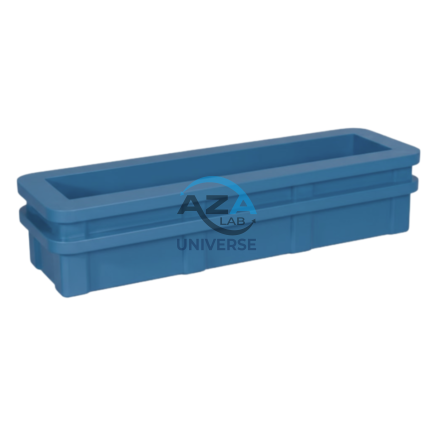
The Azalab AZA1128 Polyurethane Beam Mould Series is engineered for casting concrete beam specimens used in flexural strength tests. Built from high-impact, shock-absorbing polyurethane, these moulds deliver exceptional durability, dimensional accuracy, and ease of handling. Their lightweight yet robust design makes them suitable for both laboratory and field applications.
Polyurethane offers superior resilience compared to traditional metal or rigid plastic alternatives, enabling these moulds to withstand vibration, repeated use, and environmental exposure. The smooth internal finish ensures clean, damage-free demoulding, while the mould structure maintains consistency across multiple cycles.
Each AZA1128 mould complies with IS 516, ASTM C78, and BS 1881, ensuring reliable and standardized test preparation.
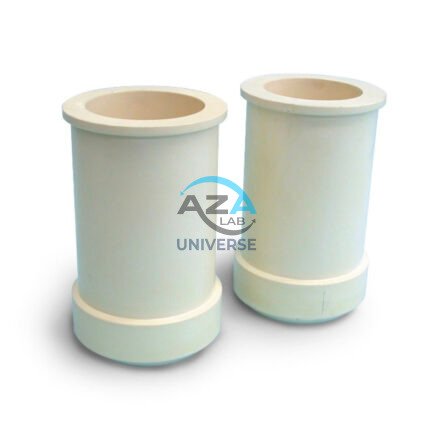
PLASTIC CYLINDERICAL MOULD AZA1127
| Model No. | Size | Material | Weight |
|---|---|---|---|
| AZA 1127 A | 150 mm × 300 mm | Polyurethane | 1.65 kg |
| AZA 1127 B | 100 mm × 200 mm | Polyurethane | 0.90 kg |
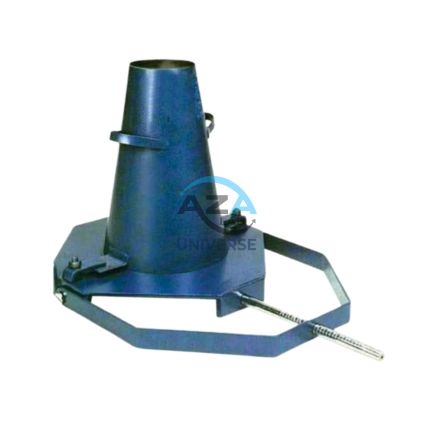

SLUMP TEST APPARATUS AZA1102
AZA1102 Slump Test Apparatus is designed for the accurate evaluation of concrete workability and consistency in both laboratory and field conditions. It is an essential quality control tool used in construction projects, civil engineering laboratories, and educational institutions.
This apparatus complies with IS 7320 and BS 1881-102 standards, ensuring reliable and standardized test results. It is primarily used to determine the slump value of fresh concrete, indicating its ease of placement, compaction, and finishing.
The set includes a durable metal slump cone manufactured to standard dimensions — 200 mm bottom diameter, 100 mm top diameter, and 300 mm height — providing dimensional accuracy and long service life. A 16 mm diameter tamping rod, 600 mm long with rounded ends, is provided to properly compact the concrete sample in layers.
The apparatus is suitable for testing concrete with aggregate sizes up to 38 mm, making it ideal for common residential, commercial, and infrastructure applications.
To improve handling and stability, the unit includes a rigid base plate with clamping arrangements and lifting handles, making it easy to use both on construction sites and in laboratories.
The AZA1102 Slump Test Apparatus is known for its simple operation, rugged construction, high accuracy, and low maintenance, making it a dependable choice for routine concrete testing.
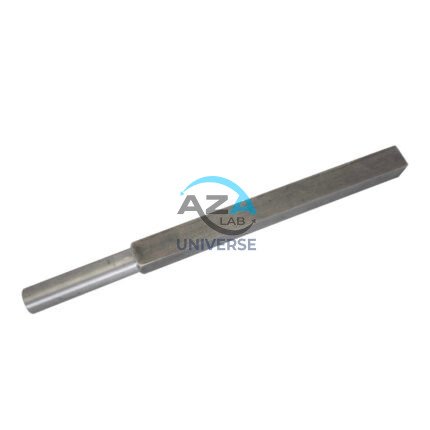
TAMPING ROD AZA1119
The AZA1119 Tamping Rod is a precision-engineered tool designed for proper compaction of concrete during laboratory and field testing. Essential for slump tests, cube/cylinder preparation, and unit weight determination, this rod ensures accurate removal of air voids, resulting in reliable and repeatable test outcomes.
Manufactured from hardened high-grade steel or stainless steel, the rod maintains dimensional accuracy, bending resistance, and a corrosion-proof finish. Each unit is polished to a smooth surface and features hemispherical ends to prevent mold damage and ensure uniform rodding action. The AZA1119 conforms to ASTM C143, ASTM C192, ASTM C138, IS 1199, and other major testing standards.
It is available in 16 mm and 25 mm diameters, with standard lengths of 600 mm (optional 450 mm). The rods are suitable for use in construction materials labs, QC departments, R&D centers, and field sampling units.