 Rock
Rock Aggregate
 Cement
 Concrete
 Soil
Soil Steel
Steel Bitumen/Asphalt
 Security Survey Equipment
 General Items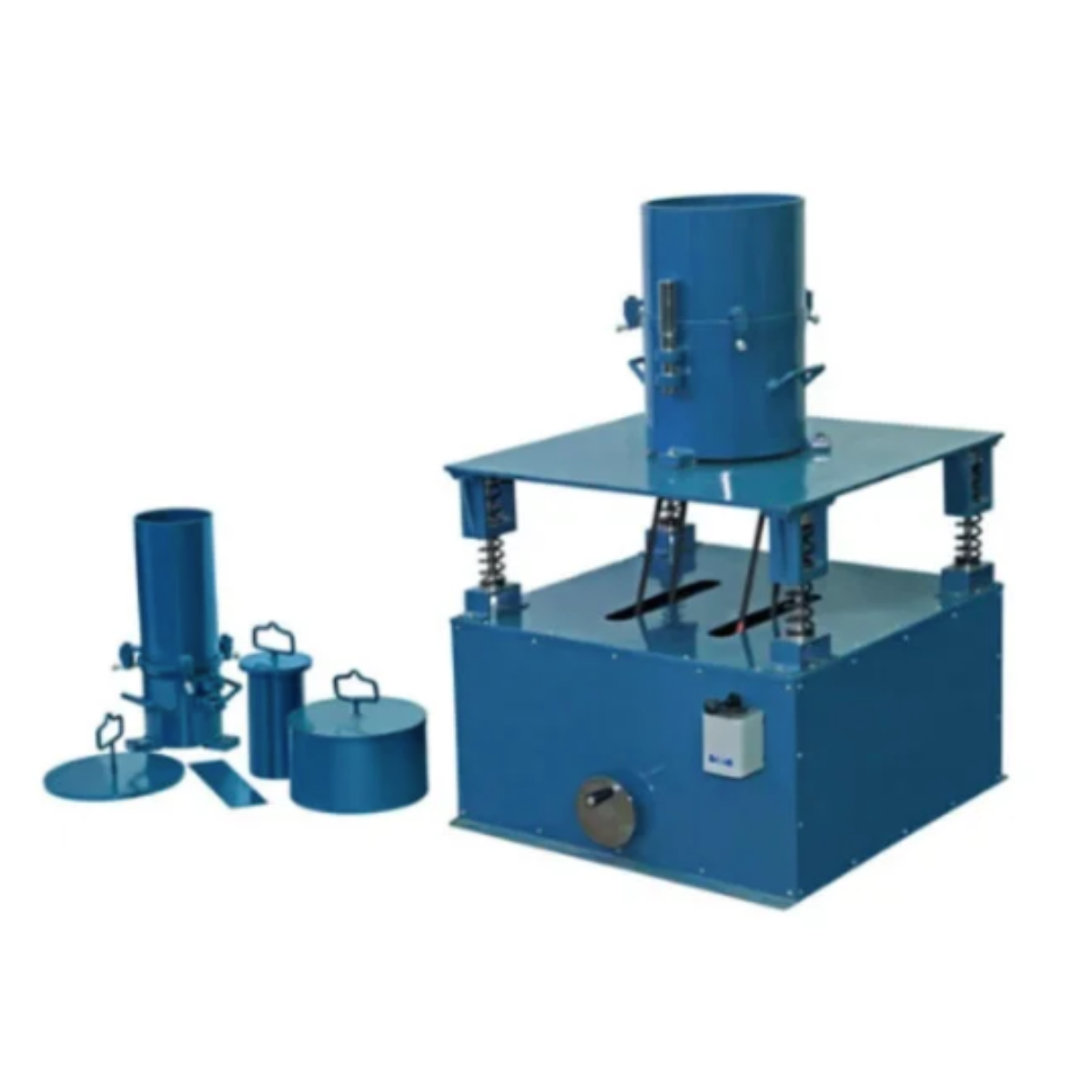
Key Features & Benefits
-
High-Frequency Vibratory Table
Simulates field compaction conditions to achieve maximum dry density with consistency. -
Variable Amplitude Control
Adjustable vibration amplitude allows optimization for different soil gradations. -
Dual Mould Capacity
Supplied with 3000 ml and 15000 ml cylindrical moulds to suit varying particle sizes. -
Standardized Surcharge System
Ensures uniform pressure application for repeatable and compliant test results. -
Precision Measurement
Dial gauge with fine resolution enables accurate deformation measurement. -
Heavy-Duty Construction
Robust steel frame and precision-machined components for long-term laboratory use.
Typical Components Supplied
-
Vibratory Table with cushioned steel deck
-
Cylindrical Metal Unit Weight Mould – 3000 ml
-
Cylindrical Metal Unit Weight Mould – 15000 ml
-
Guide sleeves with clamp assemblies (for each mould)
-
Surcharge base plates with handles
-
Surcharge weights (to achieve standard pressure)
-
Dial gauge (0.01 mm x 50 mm travel)
-
Dial gauge extension rod (25 mm)
Technical Specifications
| Feature | Description |
|---|---|
| Model | AZA0886 |
| Test Type | Relative Density Test |
| Soil Type | Cohesionless, free-draining soils |
| Vibratory Table Size | Approx. 750 × 750 mm |
| Vibration Frequency | ~3600 vibrations/min (under standard load) |
| Amplitude Range | 0.05 mm – 0.65 mm (step-adjustable) |
| Mould Capacities | 3000 ml & 15000 ml |
| Dial Gauge | 0.01 mm resolution, 50 mm travel |
| Power Supply | 415 V, 3 Phase (others on request) |
| Construction | Heavy-duty steel, corrosion-resistant finish |
Applications
-
Geotechnical Engineering
Foundation design, embankments, retaining structures -
Liquefaction Assessment
Evaluation of granular soil behavior in seismic zones -
Soil Classification
Determination of density index for granular soils -
Construction Quality Control
Verification of compaction quality in granular fills -
Academic & Research Laboratories
Test Principle (Summary)
-
Soil is placed in the mould in its loosest state to determine minimum density.
-
Soil is vibrated under surcharge using the vibratory table to achieve maximum density.
-
Relative density is calculated using the measured dry densities or void ratios.
This method provides accurate characterization of soils that cannot be evaluated using conventional Proctor compaction tests.
FAQs – AZA0886
Q1: What does the AZA0886 measure?
Determines the relative density (density index) of cohesionless soils.
Q2: Why is vibration used instead of impact?
Granular soils respond best to vibration, which simulates real field compaction.
Q3: What soils are suitable for this test?
Sands and gravels with free-draining characteristics.
Q4: Are multiple mould sizes included?
Yes, 3000 ml and 15000 ml moulds are supplied as standard.
Q5: Which standards does the equipment comply with?
IS 2720 (Part XIV), ASTM D 4253, ASTM D 4254.
AZA0886 – Reliable Relative Density Determination for Granular Soils
Precision-engineered by Azalab for accurate, repeatable, and standard-compliant geotechnical testing.