 Rock
Rock Aggregate
 Cement
 Concrete
 Soil
Soil Steel
Steel Bitumen/Asphalt
 Security Survey Equipment
 General Items
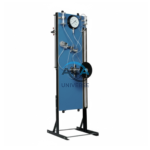
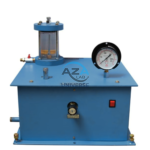
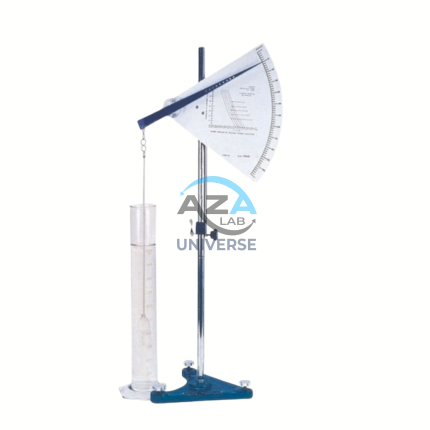
During triaxial and permeability testing, even very small volume changes can significantly influence soil behavior interpretation. The AZA0906 connects directly in-line with the drainage or back-pressure circuit of the triaxial system and records water movement using a precision-calibrated burette or piston mechanism. Its high resolution ensures that minute volume changes are captured accurately and repeatably throughout the test duration.This makes the AZA0906 indispensable for laboratories performing effective stress analysis, stress-path studies, and advanced soil research.
Applications
The AZA0906 Volume Change Gauge is widely used in:
- CU and CD triaxial shear tests
- Soil consolidation and swelling studies
- Permeability testing of cohesive soils
- Volumetric strain measurement under controlled drainage
- Academic research and commercial geotechnical laboratories
Measured data from the AZA0906 is used to determine key soil parameters such as volume compressibility, bulk modulus, coefficient of permeability, and dilation characteristics.
Construction & Features
- Precision borosilicate glass or acrylic burette (typically 50–100 ml)
- Clearly calibrated scale with ±0.1 ml resolution
- Smooth, low-friction plunger or piston mechanism
- Optional dial gauge or LVDT for displacement measurement
- Pressure-tight drainage and back-pressure connection ports
- Rigid metal frame with vertical mounting and leveling base
- Leak-proof design to prevent air entrapment and data errors
Optional digital upgrades allow integration with automated data acquisition systems for continuous logging and analysis.
Standards & Compliance
The AZA0906 is designed in accordance with major international soil testing standards:
- ASTM D4767 – Consolidated Undrained Triaxial Compression Test
- BS 1377 Part 7 – Effective Stress and Triaxial Tests
- IS 2720 (Part 11 & 12) – Triaxial and Consolidation Tests
Key Benefits
- High-precision measurement of soil volume change
- Suitable for manual and digital triaxial systems
- Stable, vibration-free mounting for consistent readings
- Essential for effective stress and volumetric behavior analysis
- Durable, corrosion-resistant construction for long-term use
Specifications – AZA0906
| Feature | Specification |
|---|---|
| Model Number | AZA0906 |
| Measurement Range | 0 – 100 ml (customizable) |
| Burette Type | Borosilicate Glass / Acrylic |
| Graduation | 0.1 ml / 0.2 ml |
| Reading Method | Graduated Scale / Dial Gauge / LVDT (optional) |
| Mounting | Vertical Stand with Leveling Base |
| Connections | Drain / Back Pressure Ports (Quick Connect) |
| Operating Pressure | Up to 10 kg/cm² |
| Compatibility | Triaxial, Permeability, Consolidation Systems |
| Optional Upgrades | Digital Indicator, LVDT, Data Logger |
| Standards Compliance | ASTM D4767, BS 1377 Part 7, IS 2720 |
Frequently Asked Questions (FAQ)
Q1: What is the primary function of the AZA0906 Volume Change Gauge?
A1: It measures the volume of water entering or leaving a saturated soil specimen during triaxial, permeability, or consolidation testing.Q2: Can the AZA0906 be connected to digital systems?
A2: Yes. Optional LVDT or digital displacement sensors allow real-time data acquisition and logging.Q3: Is the AZA0906 suitable for both CU and CD tests?
A3: Yes. It is ideal for any triaxial test requiring precise volume change measurement under controlled drainage.Q4: What level of accuracy does the gauge provide?
A4: Typical resolution is 0.1 to 0.2 ml, depending on the configuration.Q5: Does the AZA0906 include mounting accessories?
A5: Yes. It is supplied with a stable vertical stand or mounting frame for secure laboratory operation.
Volume Change Gauge for Triaxial & Permeability Tests
Ideal for CU and CD Testing of Saturated Soils
High-Resolution Volume Measurement
Manual or Digital Configurations Available
Azalab Precision for Reliable Geotechnical Analysis