Rock
Rock Aggregate
 Cement
 Concrete
 Soil
Soil Steel
Steel Bitumen/Asphalt
 Security Survey Equipment
 General Items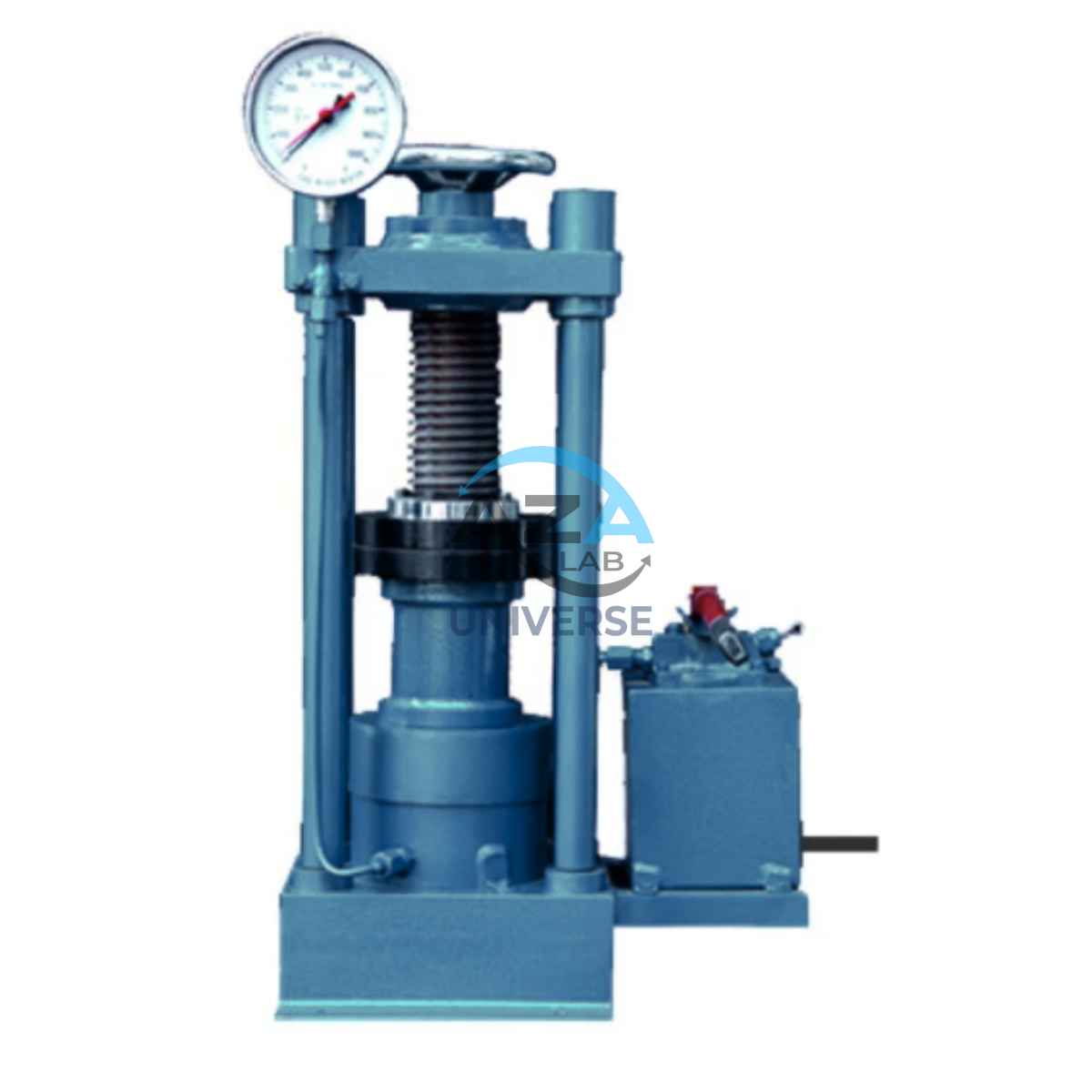
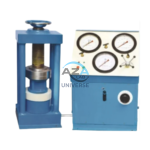
COMPRESSION TESTING MACHINE (CHANNEL TYPE LOAD FRAME) HAND OPERATED AZA1133
The AZA1133 Compression Testing Machine is a robust, hand-operated channel-frame system engineered to deliver accurate and repeatable compressive strength measurements for concrete cubes, cylinders, bricks, blocks, and similar construction materials. Designed with a heavy-duty C-channel welded frame, this unit ensures outstanding rigidity, minimal deflection, and long service life, making it ideal for quality control labs, construction sites, research institutions, and material testing facilities.
The machine conforms to IS 516 and BS 1881 requirements for compression testing and maintains precise alignment through a self-adjusting spherical seat on the upper platen. Manual load application is facilitated through a central hydraulic jack and precision lead screw assembly. All platens are hardened, machined, and mirror-polished, providing uniform load transfer and repeatable results.
Key Features
- Heavy C-channel welded frame for exceptional stability and structural durability
- Fully compliant with IS 516 and BS 1881 standards
- Available capacities from 50 kN to 2000 kN
- Hardened, ground, mirror-polished platens with centering grooves
- Manual operation using hydraulic jack and precision lead screw
- Self-aligning spherical seat on upper platen
- Rectangular platens standard; square/circular optional
- Suitable for cubes, cylinders, bricks, blocks, and tiles
Description
Technical Specifications
| Feature | Details |
|---|---|
| Compliance | IS 516, BS 1881 |
| Capacity Range | 50 kN – 2000 kN |
| Frame Design | Rigid C-channel welded structure (top & bottom) |
| Hydraulic Jack | Centrally mounted manual hydraulic jack |
| Operation | Hand operated via lead screw |
| Upper Platen | Fixed to lead screw; spherical seat for auto-alignment |
| Lower Platen | With centering pin and alignment grooves |
| Platen Finish | Hardened, machined, mirror-polished |
| Platen Shape | Rectangular (optional square/circular) |
| Display | Analog dial gauge (digital variant optional) |
| Application | Concrete cubes, cylinders, bricks, blocks, tiles |
Available Models
| Model No. | Capacity | Frame Type | Operation | Gauge Type |
|---|---|---|---|---|
| AZA1133-050 | 50 kN | Channel Type | Hand Operated | Analog Dial |
| AZA1133-100 | 100 kN | Channel Type | Hand Operated | Analog Dial |
| AZA1133-1000 | 1000 kN | Channel Type | Hand Operated | Analog (Digital Optional) |
| AZA1133-2000 | 2000 kN | Channel Type | Hand Operated | Analog (Digital Optional) |
Applications
-
Concrete cube and cylinder testing
-
Brick and block strength evaluation
-
Cement product QC testing
-
Construction site material verification
-
Research and academic laboratories
-
Precast and RMC plant quality assurance
Frequently Asked Questions (FAQ)
Q1: Why is the spherical seat important?
It ensures automatic alignment between the platens and specimen, allowing uniform load distribution and minimizing stress concentrations.
Q2: What specimen types can be tested?
Concrete cubes (150 mm), cylinders (150×300 mm), bricks, blocks, and tiles when appropriate spacers are used.
Q3: What advantages does a C-channel frame provide?
It offers superior load-bearing strength, high rigidity, reduced deflection, and sustained accuracy under repeated testing.
Q4: Are custom platen shapes available?
Yes. Square and circular platens can be provided on request at an additional cost.
Q5: Is calibration included?
Yes. Each machine is supplied with a calibration certificate issued using certified proving rings.
Additional information
| Compliance |
IS 516, BS 1881 |
|---|---|
| Capacity Range |
50 kN to 2000 kN (custom selection) |
| Frame Design |
Rigid C-channel welded top & bottom structure |
Related products

CHASE AIR INDICATOR AZA1105
AZA1105 Chase Air Indicator is a compact, lightweight, and highly practical field instrument designed to measure the air content in freshly mixed concrete. It is widely used in construction sites where rapid quality decisions are required and laboratory testing equipment is not readily available.
This device serves as a reliable field alternative to standard air content methods such as ASTM C231 (Pressure Method) and ASTM C173 (Volumetric Method). While it is not intended to replace laboratory-grade instruments, it provides fast, useful guidance that helps engineers and site supervisors maintain proper concrete mix quality.
Air entrainment plays a critical role in concrete durability, especially in regions exposed to freeze–thaw cycles, and contributes significantly to workability and pumpability of concrete. AZA1105 helps ensure that air content remains within the recommended range (typically 4%–7%), reducing the risk of weak or brittle concrete.
The working principle is based on fluid displacement and vacuum pressure balance. A representative mortar sample is collected and placed inside the testing chamber, where a controlled vacuum is applied. The internal pressure difference is translated directly to a calibrated dial gauge showing the approximate air content percentage.
With no electrical components, moving mechanical assemblies, or complex maintenance requirements, the AZA1105 is extremely reliable and built for tough field conditions. Its rugged body and easy-to-read dial make it suitable for continuous daily use in real-world jobsite environments.
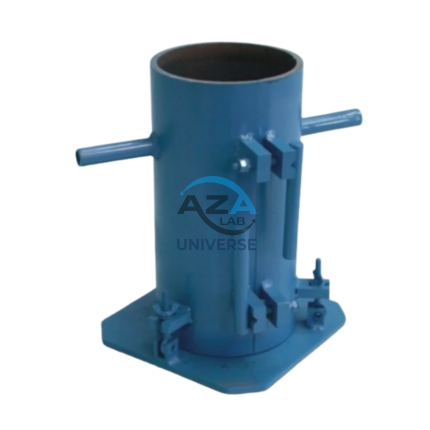
CYLINDRICAL MOULD AZA1123
Purpose & Function
The cylindrical mould is used to prepare concrete specimens of standard dimensions, typically:- 150 mm diameter × 300 mm height
- 100 mm diameter × 200 mm height
- Compressive strength tests
- Split tensile strength tests
- Elastic modulus evaluations
- Durability and material behavior studies

L SHAPE BOX APPARATUS AZA1112
AZA1112 L Shape Box Apparatus is a precision testing device designed to evaluate the passing ability and flow performance of Self-Compacting Concrete (SCC) in congested reinforcement conditions. This apparatus simulates real-world scenarios such as densely reinforced beams, columns, tunnels, and bridge segments, where concrete must flow freely without segregation or blockage.
The distinctive L-shaped design creates a controlled flow path where freshly mixed SCC moves from a vertical chamber into a horizontal channel containing reinforcement bars. By measuring the concrete heights at both ends (H1 and H2), the H2/H1 ratio is calculated, providing a direct, quantitative assessment of the concrete’s ability to pass through obstructions.
Manufactured from durable, corrosion-resistant steel, AZA1112 is built for long-term laboratory and site use. It conforms to EN 12350-10 and EFNARC guidelines, ensuring global acceptance of test results.
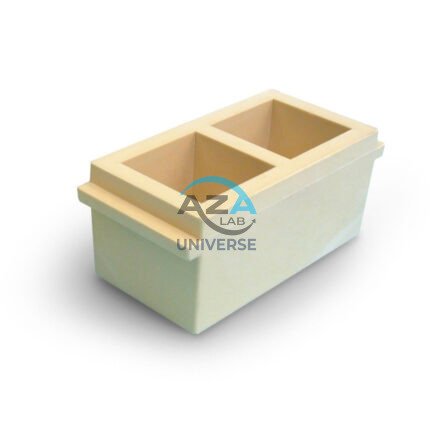
PLASTIC CUBE MOULD AZA1126
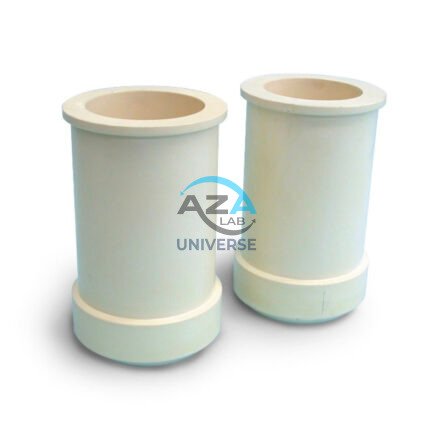
PLASTIC CYLINDERICAL MOULD AZA1127
| Model No. | Size | Material | Weight |
|---|---|---|---|
| AZA 1127 A | 150 mm × 300 mm | Polyurethane | 1.65 kg |
| AZA 1127 B | 100 mm × 200 mm | Polyurethane | 0.90 kg |

SLUMP TEST APPARATUS AZA1102
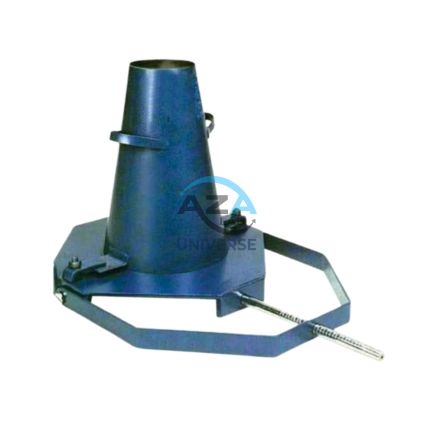
AZA1102 Slump Test Apparatus is designed for the accurate evaluation of concrete workability and consistency in both laboratory and field conditions. It is an essential quality control tool used in construction projects, civil engineering laboratories, and educational institutions.
This apparatus complies with IS 7320 and BS 1881-102 standards, ensuring reliable and standardized test results. It is primarily used to determine the slump value of fresh concrete, indicating its ease of placement, compaction, and finishing.
The set includes a durable metal slump cone manufactured to standard dimensions — 200 mm bottom diameter, 100 mm top diameter, and 300 mm height — providing dimensional accuracy and long service life. A 16 mm diameter tamping rod, 600 mm long with rounded ends, is provided to properly compact the concrete sample in layers.
The apparatus is suitable for testing concrete with aggregate sizes up to 38 mm, making it ideal for common residential, commercial, and infrastructure applications.
To improve handling and stability, the unit includes a rigid base plate with clamping arrangements and lifting handles, making it easy to use both on construction sites and in laboratories.
The AZA1102 Slump Test Apparatus is known for its simple operation, rugged construction, high accuracy, and low maintenance, making it a dependable choice for routine concrete testing.
TAMPING ROD AZA1119
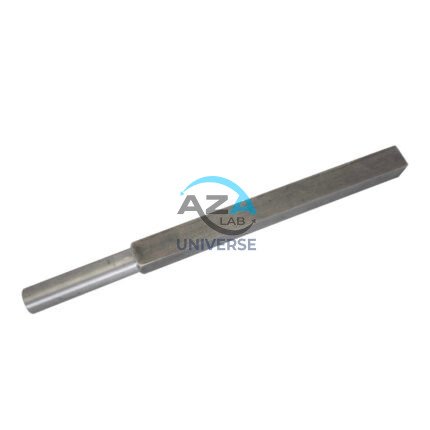
The AZA1119 Tamping Rod is a precision-engineered tool designed for proper compaction of concrete during laboratory and field testing. Essential for slump tests, cube/cylinder preparation, and unit weight determination, this rod ensures accurate removal of air voids, resulting in reliable and repeatable test outcomes.
Manufactured from hardened high-grade steel or stainless steel, the rod maintains dimensional accuracy, bending resistance, and a corrosion-proof finish. Each unit is polished to a smooth surface and features hemispherical ends to prevent mold damage and ensure uniform rodding action. The AZA1119 conforms to ASTM C143, ASTM C192, ASTM C138, IS 1199, and other major testing standards.
It is available in 16 mm and 25 mm diameters, with standard lengths of 600 mm (optional 450 mm). The rods are suitable for use in construction materials labs, QC departments, R&D centers, and field sampling units.

V FUNNEL AZA1111
AZA1111 V Funnel is a precision laboratory apparatus designed to measure the flow time and viscosity of Self-Compacting Concrete (SCC). It evaluates how quickly fresh SCC passes through a narrow, V-shaped section under the action of gravity, providing critical insight into the concrete’s workability, stability, and resistance to segregation.
The V Funnel test is essential when designing SCC mixes that must flow through heavily reinforced or congested formwork. By recording the time taken for concrete to completely discharge from the funnel, the apparatus allows engineers and technicians to quickly judge whether a mix is too stiff, too viscous, or optimally balanced.
Manufactured with a durable, corrosion-resistant metal body and a precise quick-release gate mechanism, AZA1111 ensures smooth, repeatable testing. Its rigid structure and stable stand make it suitable for both laboratory and site-based quality control environments.
The equipment is designed in compliance with EN 12350-9 and EFNARC guidelines, ensuring globally accepted and repeatable test results