
 Rock
 Aggregate
 Cement
 Concrete
 Soil
 Steel
 Bitumen/Asphalt
 Security Survey Equipment
 General Items


ULTRASONIC PULSE VELOCITY TESTER AZA1151
The AZA1151 Ultrasonic Pulse Velocity (UPV) Tester is a high-precision, nondestructive testing instrument engineered to evaluate the quality, uniformity, and integrity of concrete and various construction materials. By measuring the travel time of ultrasonic pulses through concrete, the device accurately identifies variations in density, internal flaws, cracks, voids, and other structural discontinuities.Designed for both field and laboratory environments, the AZA1151 combines portability, digital precision, and rugged performance. Its intuitive interface and data-logging capabilities make it ideal for engineers, consultants, QC inspectors, and researchers involved in civil and structural assessment.
Key Features
-
- Digital LCD Display: Real-time pulse velocity readings for fast decision-making.
- Data Logging: Stores up to 500 readings for later retrieval and analysis.
- High Accuracy: Precision-engineered electronics minimize user error and deliver consistent results.
- Portable & Lightweight: Built for field inspections and long working hours.
- Durable Probes: Rugged transducers ensure reliable ultrasonic transmission.
- Rechargeable Battery: Long operating lifespan suitable for on-site testing.
- USB Connectivity: Easy data export to PC for reporting and documentation.
Description
Applications
-
Quality evaluation of concrete in bridges, dams, tunnels, and buildings
-
Detection of cracks, voids, honeycombing, and internal defects
-
Monitoring uniformity and homogeneity of concrete during curing
-
Testing rocks, bricks, and other construction materials
-
Material research, academic studies, and structural assessment programs
Standards Compliance
The AZA1151 meets globally recognized standards, ensuring reliability and widespread acceptance of results:
-
ASTM C597 – Standard Test Method for Pulse Velocity Through Concrete
-
IS 13311 (Part 1) – Ultrasonic Pulse Velocity
Specifications
| Feature | Specification |
|---|---|
| Model | AZA1151 |
| Measurement Principle | Ultrasonic Pulse Velocity |
| Display | Digital LCD |
| Data Storage | Up to 500 test results |
| Connectivity | USB |
| Power Supply | Rechargeable Lithium Battery |
| Operating Temperature | 0°C to 45°C |
| Compliance Standards | ASTM C597, IS 13311 |
| Weight | Approx. 2.0 kg |
| Dimensions | 250 mm × 100 mm × 50 mm |
Frequently Asked Questions (FAQ)
Q1: What materials can be tested with the AZA1151?
A1: Primarily concrete, but it also works effectively with rocks, bricks, and similar solid materials.
Q2: Is the device suitable for on-site testing?
A2: Yes. Its portable, rugged design makes it ideal for field inspections in harsh environments.
Q3: How does data storage work?
A3: The device stores up to 500 readings internally, which can be transferred via USB for reporting.
Q4: Does the tester require special training?
A4: Basic understanding of UPV testing is recommended, but the device itself is user-friendly.
Q5: What is the battery life?
A5: Typically up to 8 hours of continuous operation on a full charge.
Why Choose AZALAB?
-
Genuine, calibrated NDT instruments
-
Expert technical support and guidance
-
Reliable warranty and after-sales service
-
Fast dispatch and support for institutional & bulk orders
Additional information
| Model |
AZA 1151 |
|---|---|
| Measurement Principle |
Ultrasonic Pulse Velocity |
| Display |
Digital LCD |
| Weight |
Approx. 2.0 kg |
| Dimensions |
250 mm x 100 mm x 50 mm |
Related products

CONCRETE FLOW TABLE TEST SET AZA1110
AZA1110 Concrete Flow Table Test Set is a precision-engineered laboratory apparatus designed to determine the workability, consistency, and flow characteristics of fresh concrete. It is especially suitable for Self-Compacting Concrete (SCC), precast concrete, and high-consistency mixes where the traditional slump test is not effective.
This test set works by allowing a freshly mixed concrete sample to spread under controlled, repeated vertical jolts of a mechanically calibrated table. The final spread diameter of the concrete is measured to assess its flowability and uniformity.
Built with a rigid, precisely machined table surface, the AZA1110 ensures repeatable and reliable results. Its heavy-duty construction allows long-term use in demanding laboratory environments while remaining easy to clean, store, and maintain.
The apparatus complies with major international standards including IS 1199, ASTM C1437, and BS EN 12350-5, making it suitable for both domestic and international testing requirements.
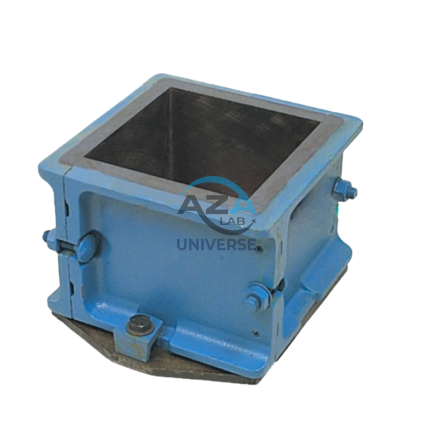
CUBE MOULD (METAL) AZA1122
Purpose & Function
This mould supports the preparation of standardized cube specimens that are used in:- Compressive strength testing
- Batch-wise quality control in construction
- Concrete mix design validation
- Research on material performance and durability

J-RING, NARROW GAP AZA1109
AZA1109 J-Ring – Narrow Gap is a precision testing apparatus designed to evaluate the passing ability of Self-Compacting Concrete (SCC) under highly restrictive conditions. This device simulates densely congested reinforcement zones by creating artificial obstructions that the fresh SCC must flow through without blocking or segregating. It is an essential tool for determining whether SCC mixes are suitable for heavily reinforced structural elements such as beams, columns, and shear walls.
The narrow gap design offers a more stringent test compared to standard J-Rings, allowing engineers and quality control professionals to accurately observe flow diameter, T50 flow time, and blocking behavior. When used in combination with a standard slump flow cone, AZA1109 provides reliable, repeatable results that help optimize mix designs and ensure consistent on-site performance.
Manufactured from durable, corrosion-resistant steel, the AZA1109 is built for repeated use in laboratory and field testing environments. The apparatus is fully compliant with ASTM C1621 and EFNARC guidelines, ensuring internationally accepted testing procedures.

K-SLUMP TESTER AZA1104
AZA1104 K-Slump Tester is a fast, reliable, and non-destructive testing device designed to measure the workability and consistency of fresh concrete directly at construction sites or in laboratory environments. It provides instant slump approximation without the need for traditional slump cones, base plates, or tamping rods, making it an essential tool for modern concrete quality control.
This handheld instrument is widely used by civil engineers, site technicians, and quality inspectors who require quick, repeatable, and real-time results during concrete batching, transportation, and placement. Its simple design eliminates complicated setup, reducing testing time and operator fatigue.
Manufactured from high-grade stainless steel, the probe is corrosion-resistant and suitable for harsh site conditions. The etched scale markings provide direct readings in millimeters or inches, allowing accurate penetration depth measurement without additional instruments.
Unlike traditional slump testing methods, the AZA1104 enables non-destructive testing, meaning the concrete surface remains intact and usable after testing. This feature is especially useful when multiple checks are needed during large pours or continuous batching operation
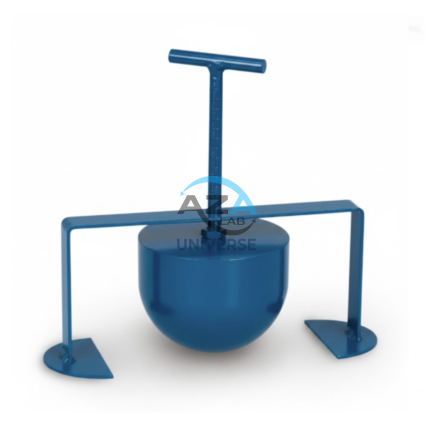
KELLEY BALL PENETRATION APPARATUS AZA1106
- Direct workability assessment using steel ball penetration
- Fully compliant with ASTM C360
- Portable and rugged for field and lab testing
- Heavy-duty steel/aluminum frame for long-term durability
- Built-in scale for accurate depth measurement
- Simple setup and low maintenance
- Provides a reliable alternative to the slump test

L SHAPE BOX APPARATUS AZA1112
AZA1112 L Shape Box Apparatus is a precision testing device designed to evaluate the passing ability and flow performance of Self-Compacting Concrete (SCC) in congested reinforcement conditions. This apparatus simulates real-world scenarios such as densely reinforced beams, columns, tunnels, and bridge segments, where concrete must flow freely without segregation or blockage.
The distinctive L-shaped design creates a controlled flow path where freshly mixed SCC moves from a vertical chamber into a horizontal channel containing reinforcement bars. By measuring the concrete heights at both ends (H1 and H2), the H2/H1 ratio is calculated, providing a direct, quantitative assessment of the concrete’s ability to pass through obstructions.
Manufactured from durable, corrosion-resistant steel, AZA1112 is built for long-term laboratory and site use. It conforms to EN 12350-10 and EFNARC guidelines, ensuring global acceptance of test results.
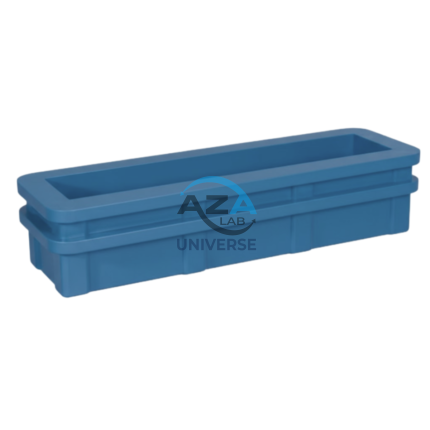
PLASTIC BEAM MOULD AZA1128
The Azalab AZA1128 Polyurethane Beam Mould Series is engineered for casting concrete beam specimens used in flexural strength tests. Built from high-impact, shock-absorbing polyurethane, these moulds deliver exceptional durability, dimensional accuracy, and ease of handling. Their lightweight yet robust design makes them suitable for both laboratory and field applications.
Polyurethane offers superior resilience compared to traditional metal or rigid plastic alternatives, enabling these moulds to withstand vibration, repeated use, and environmental exposure. The smooth internal finish ensures clean, damage-free demoulding, while the mould structure maintains consistency across multiple cycles.
Each AZA1128 mould complies with IS 516, ASTM C78, and BS 1881, ensuring reliable and standardized test preparation.
PLASTIC MOULDS AZA1125
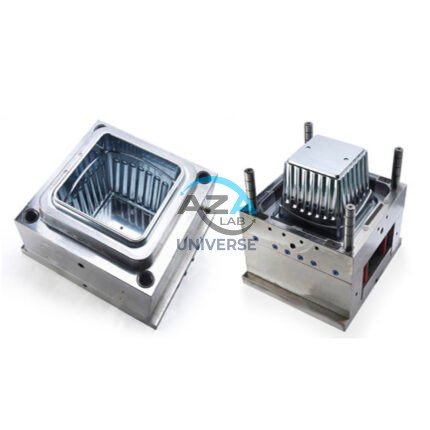
The AZA1125 One-Piece Plastic Cube Mould (150 mm) from Azalab is a next-generation alternative to traditional metal cube moulds. Built from high-strength, non-deformable engineering plastic, this mould is designed to offer superior ease of use, long service life, and consistent dimensional accuracy for concrete compressive strength testing.
Its seamless, single-piece construction eliminates the need for bolts, screws, or external frames. Users simply apply demoulding oil, cast the concrete, and after curing, eject the cube using compressed air or water pressure, achieving clean and damage-free removal every time.
Compared to heavy metal moulds, the AZA1125 weighs nearly 90% less, providing clear advantages in portability, handling, and storage—making it ideal for both laboratory and on-site testing environments. Manufactured using an eco-friendly, non-polluting process, this mould supports sustainability goals in modern construction testing.