
 Rock
Rock Aggregate
 Cement
 Concrete
 Soil
Soil Steel
Steel Bitumen/Asphalt
 Security Survey Equipment
 General Items
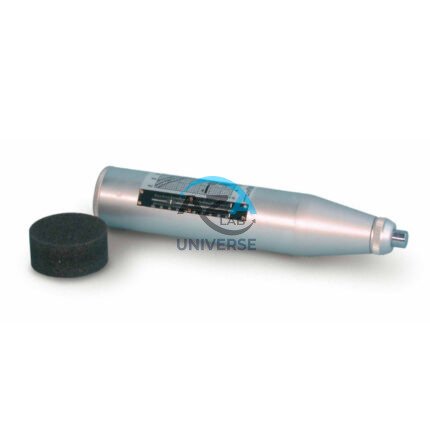
CONCRETE TEST HAMMER (SCHMIDT HAMMER) N TYPE AZA1148
How It Works
The hammer uses a spring-loaded mass that impacts the concrete surface. The rebound distance of the mass (displayed as an R-value) correlates to the concrete’s surface hardness and indirectly indicates compressive strength. Results can be interpreted using standard conversion charts or custom calibration curves based on local materials.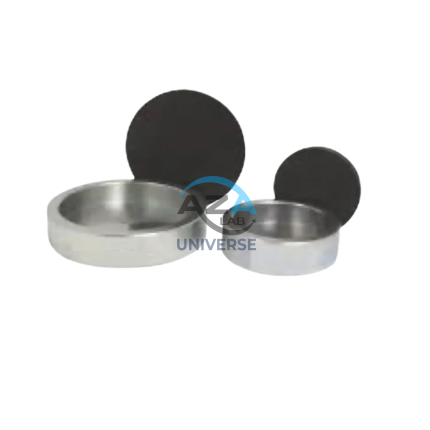
CONCRETE: PAD CAPS AND RETAINER RINGS AZA1162
High-Precision Retainer Rings
Manufactured from plated high-alloy steel, the retainer rings are corrosion-resistant and capable of handling repeated load cycles without deformation. Each ring is precision-machined to a tolerance of ≤ 0.002", ensuring flat, uniform bearing surfaces for consistent load transfer during testing.Neoprene Pad Inserts
Durable neoprene pads fit securely within the retainer rings and adapt to minor surface irregularities at the ends of concrete cylinders. The elastomeric material provides uniform stress distribution and high repeatability across all tests. Pads are available in multiple durometers (50, 60, 70) depending on the compressive strength range.Universal Compatibility
The pad cap system is suitable for standard concrete cylinder sizes used in laboratories and field QA/QC testing, including 4" × 8" and 6" × 12" specimens. Rings are reusable, and pads are replaceable, providing long-term operational efficiency.Ideal For
• Concrete testing laboratories• Field quality control/quality assurance
• Precast and ready-mix production plants
• Research and education institutions
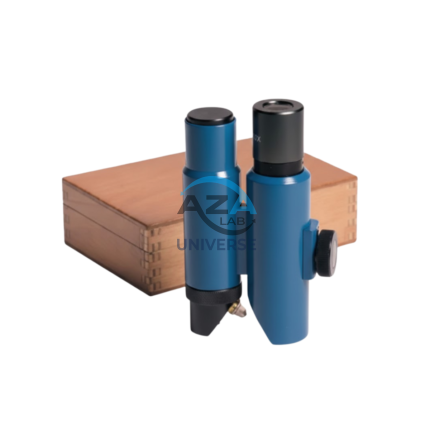
CRACK MICROSCOPE AZA1153
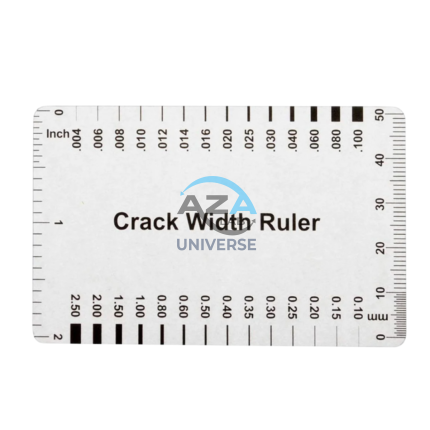
CRACK WIDTH RULER AZA1147
Key Applications
- Structural health monitoring
- Routine inspection of concrete surfaces
- Crack classification for repair planning
- Condition assessment in buildings, bridges, pavements, and tunnels
- Preventive maintenance programs
- Long-term crack propagation studies
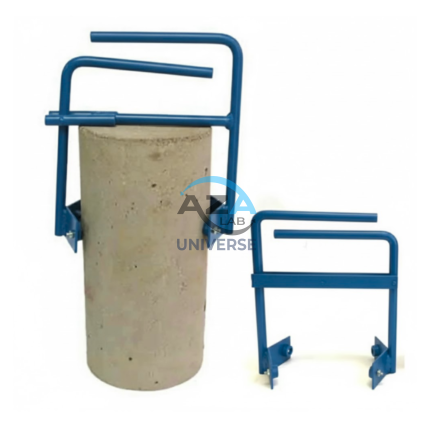
CUBE AND CYLINDER LIFTING HANDLE AZA1158
The AZA-LAB Cube & Cylinder Lifting Handle (Model AZA1158) is a robust, safety-focused tool engineered for the reliable handling of concrete cube and cylindrical specimens in material testing laboratories. Built from high-strength, powder-coated steel, this lifting handle ensures durability, corrosion resistance, and consistent performance in demanding environments, including wet curing areas and abrasive field conditions.
Designed to securely grip 100 mm and 150 mm standard concrete cube moulds and cylindrical specimens, the AZA1158 facilitates safe lifting, transfer, and positioning without direct hand contact. The adjustable locking mechanism and anti-slip jaw design provide a firm hold on the specimen, preventing slippage and minimizing the risk of surface damage.
The ergonomic handle design distributes weight evenly, reducing hand fatigue and improving workflow efficiency. Whether used for loading specimens into curing tanks, transferring them to compression testing machines, or transporting them for inspection, this tool enhances operational safety and aligns with laboratory best practices.
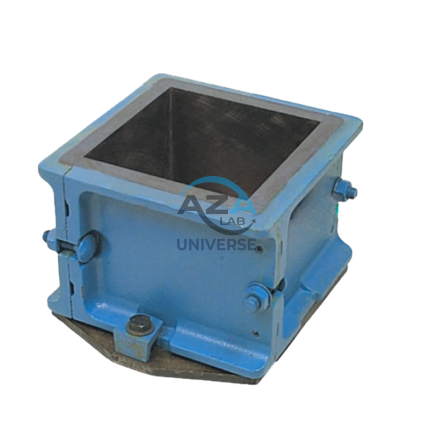
CUBE MOULD (METAL) AZA1122
Purpose & Function
This mould supports the preparation of standardized cube specimens that are used in:- Compressive strength testing
- Batch-wise quality control in construction
- Concrete mix design validation
- Research on material performance and durability
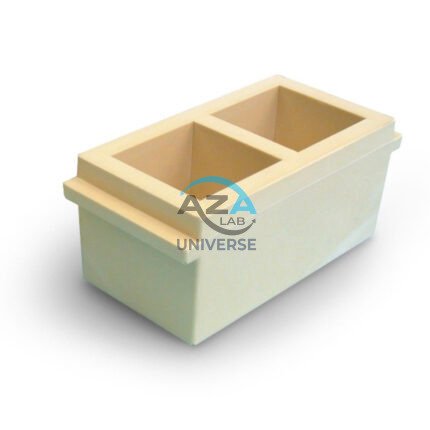
CUBE MOULD, PLASTIC AZA1155
The AZA-LAB Plastic Cube Mould (AZA1155) is a lightweight, durable, and reusable concrete mould engineered for casting standard 150 mm concrete cubes used in compressive strength testing. Built for both laboratory and field environments, this mould delivers dimensional accuracy, ease of handling, and long-term performance without the drawbacks associated with metal moulds.
Made from high-density, non-corrosive polymer, the mould resists rusting, denting, warping, and environmental degradation. It is specifically designed to perform reliably under harsh site conditions and repetitive laboratory use, making it an ideal choice for quality control operations in construction, research institutions, and material testing laboratories.
The mould comprises four interlocking sides and a solid base, ensuring stable assembly and sharp-edged cube formation. Its tight-fitting joints prevent slurry leakage during pouring and compaction, ensuring uniform specimen quality. Demoulding is effortless due to its smooth, non-stick internal surfaces—eliminating the need for excessive lubrication or hammering, and reducing the risk of damaging test specimens.
With minimal cleaning requirements and excellent resistance to cement buildup, the AZA1155 supports high-frequency testing workflows, whether at permanent laboratories or mobile field testing units.
The cube mould conforms to IS 516, BS 1881, and ASTM C39 requirements for concrete testing, ensuring compatibility with industry-standard quality control practices.
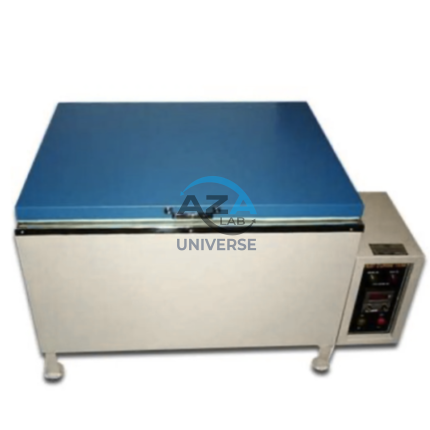
CURING TANK AZA1166
The AZA1166 Concrete Curing Tank is a critical conditioning system for concrete cube and cylinder testing laboratories. Purpose-built for civil engineering, construction QC, and material testing environments, this curing tank maintains controlled water temperatures to ensure accurate, reliable, and standard-compliant compressive strength results. It adheres to IS: 516, ASTM C511, and BS 1881 curing requirements.
Developed with durability, precision, and operational efficiency in mind, the AZA1166 is available in both manual and automated configurations, including optional digital PID controllers for enhanced temperature stability. This makes the unit suitable for laboratories, field testing units, and institutions managing high workloads or requiring strict adherence to international testing protocols.
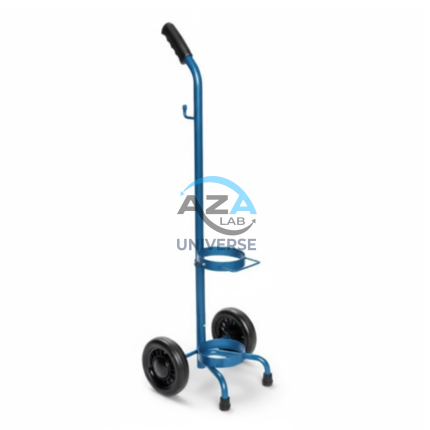
CYLINDER CARRIER AZA1160
The AZA1160 Concrete Cylinder Carrier from AZA-LAB is a precision-engineered handling tool designed for laboratories, construction sites, and field testing environments that routinely work with concrete cylinder specimens. Built for the safe and ergonomic transport of 150 mm × 300 mm concrete cylinders, this carrier ensures sample integrity throughout the curing and testing process.
Concrete cylinder specimens are fundamental in assessing compressive strength as per civil and structural engineering standards. Weighing over 15 kg when cured, these specimens are prone to chipping, cracking, or impact damage when manually handled. The AZA1160 provides a secure, stable, and balanced solution that safeguards the sample while offering ease of movement for technicians.
Manufactured using industrial-grade, powder-coated steel, the carrier delivers long-term durability, corrosion resistance, and dependable performance in wet, dusty, or chemically exposed environments. Despite its rugged construction, the frame remains lightweight, allowing repeated lifting without user fatigue.
The carrier’s custom-curved gripping arms conform to the geometry of standard cylinders, preventing rolling or lateral movement during transport. Its ergonomically placed handles ensure balanced weight distribution, enabling a single operator to carry heavy cylinders safely and comfortably. The open-frame design holds the specimen firmly while keeping both ends accessible for inspection or curing.
Engineered to support testing protocols aligned with ASTM C39 and IS 516, the AZA1160 ensures safe handling practices that contribute to accurate compressive strength testing.
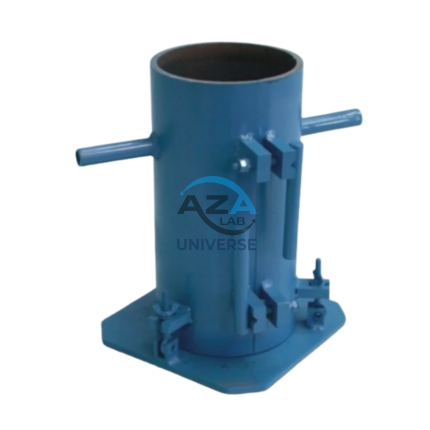
CYLINDRICAL MOULD AZA1123
Purpose & Function
The cylindrical mould is used to prepare concrete specimens of standard dimensions, typically:- 150 mm diameter × 300 mm height
- 100 mm diameter × 200 mm height
- Compressive strength tests
- Split tensile strength tests
- Elastic modulus evaluations
- Durability and material behavior studies
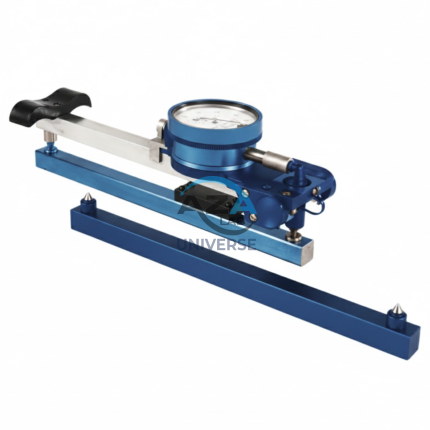
DE-MOUNTABLE MECHANICAL STRAIN GAUGE AZA1170
The AZA 1170 De-Mountable Mechanical Strain Gauge is a precision instrument designed for accurate strain measurement on concrete, rock, steel, and composite specimens. Built in full compliance with ASTM D5335, this mechanical gauge offers high-resolution deformation monitoring for both laboratory and field applications where reliability, repeatability, and portability are critical.
Unlike bonded electrical strain gauges, the AZA 1170 is reusable and non-intrusive, requiring no adhesive, wiring, or power supply. It attaches to pre-installed gauge studs and measures deformation mechanically via a micrometer-style dial gauge with an accuracy of ±0.002 mm. This makes it ideal for temporary measurements, comparative strain evaluations, and multi-point deformation studies across multiple specimens.
Engineers and researchers use this instrument widely in uniaxial/triaxial compression testing, tensile tests, rock mechanics, material durability studies, and structural health assessments in dams, tunnels, bridges, and underground structures. Its rugged yet lightweight design enables quick installation, stable readings, and efficient workflow during intensive testing cycles.
The AZA 1170 features an adjustable gauge length from 50 mm to 200 mm, with optional extension arms and interchangeable dial indicators to suit various testing protocols. All components are machined from corrosion-resistant aluminum alloy or stainless steel, ensuring dimensional stability even under harsh environmental conditions.
The system includes a calibration bar, mounting tools, and a protective carry case, enabling users to maintain accuracy and safely transport the device between field and laboratory sites.
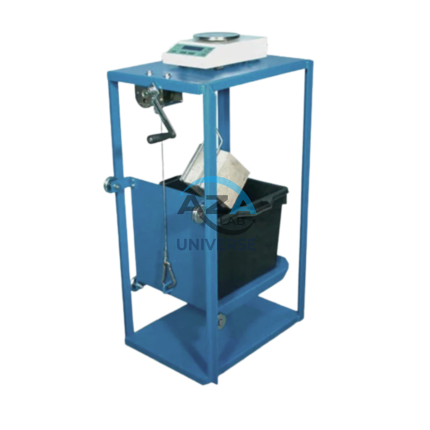
DENSITY OF FRESH AND HARDENED CONCRETE AZA1132
Key Benefits
- Dual-Purpose Instrument: Tests both fresh and hardened concrete
- High Accuracy: Provides precise results using weight–volume and displacement methods
- Standards Compliant: Meets IS 1199 and ASTM C642 testing guidelines
- Durable Construction: Built from corrosion-resistant materials for long-term use
- Field-Ready: Lightweight, portable, and suitable for lab and on-site applications
- Easy Maintenance: Simple to clean, assemble, and operate

 Rock
Rock Aggregate
 Cement
 Concrete
 Soil
Soil Steel
Steel Bitumen/Asphalt
 Security Survey Equipment
 General Items